

 FACT CHECKED
Like many other sectors, technology has long played an integral role in finance.
From digital databases that store our financial information to sophisticated systems that calculate complex transactions, the success of modern financial services is inherently linked to technology.

The rise of AI will only continue to impact banking and fintech. Major strides in data and computer sciences have seen AI graduate from the pages of science fiction. Today, AI’s applications are catapulting operational capabilities. Not just in finance but industry-wide.
The benefits of AI, from precise decision-making to pattern detection, position it as a catalyst for innovation.
In this article, we’ll explore AI in finance. We’ll define it and explore examples of how it’s used in the sector today. We’ll also uncover the top AI applications and tools the finance sector leverages.
What is AI in finance?
AI in finance involves augmenting financial services capabilities through artificial intelligence technology. Some forms of AI in finance involve training computers to learn and perform complex tasks without pre-programming.
Grandview Research reveals the global market for artificial intelligence in financial technology was worth 9.45 billion US dollars in 2021. They expect this market to grow steadily at 16.5% annually until 2030.
In finance, these systems primarily employ data-dependent AI, such as machine learning (ML) and deep learning (DL). ML in fintech teaches computers to automate activities and strengthen decision-making processes based on data they have learned.
Others often leverage rule-based AI for more acute processes, such as anomaly detection. These more stringent forms of AI are designed to identify and address specific issues with high precision.
Generative AI in Finance: 2025–2026 Applications
Generative AI — large language models and multimodal foundation models capable of producing text, code, and analysis — has moved from pilot to production across the financial sector faster than any previous wave of AI adoption. Unlike the narrow AI capabilities that preceded it (fraud classifiers, credit scorers, chatbots), generative AI can synthesize unstructured data, draft client communications, analyze earnings calls, and produce regulatory filings at scale.
Investment research and analysis. Banks and asset managers are deploying LLMs to compress equity research workflows. Tasks that previously required an analyst two to three days — reading earnings transcripts, synthesizing news, building narrative summaries — now take minutes. JPMorgan’s internal LLM, IndexGPT, processes market data to surface investment themes. Morgan Stanley’s AI assistant, built on OpenAI’s GPT-4, gives financial advisors instant access to 100,000+ research documents during client calls.
AI-powered trading and portfolio management. Generative AI is augmenting quantitative strategies by generating hypothesis-driven signals from news, regulatory filings, and social sentiment. Hedge funds including Two Sigma and Renaissance Technologies have integrated LLM-based signal generation alongside traditional quant models. Retail platforms like Schwab and Fidelity have rolled out AI copilots that explain portfolio performance in plain language and surface rebalancing suggestions.
Financial document automation. Loan origination, underwriting packages, and regulatory filings involve enormous volumes of semi-structured text. Generative AI reads, extracts, and drafts these documents with accuracy rates that now exceed 90% on standardized forms. Stripe uses LLMs internally to flag unusual contract clauses during vendor onboarding and to generate first drafts of compliance summaries for legal review.
Client communication and personalization. AI-written, personalized financial summaries — tailored to an individual’s portfolio, goals, and risk profile — are being deployed by wealth management platforms to replace generic quarterly statements. The result is higher client engagement and demonstrably fewer support calls.
AI in Finance: Real-World Company Examples
Abstract capability lists are useful, but the clearest way to understand where AI is actually deployed in finance today is through the organizations using it at scale.
JPMorgan Chase. JPMorgan is one of the most aggressive AI adopters in global banking. The firm employs over 2,000 AI and machine learning specialists. Its proprietary COiN (Contract Intelligence) platform uses natural language processing to review legal documents — a task that previously required 360,000 hours of lawyer time annually and is now completed in seconds. JPMorgan’s fraud detection models process millions of transactions daily and have reduced false-positive rates by over 20%, meaningfully improving customer experience without sacrificing security.
Goldman Sachs. Goldman has embedded AI across trading, compliance, and software engineering. Its internal developer tool, built on code-generation LLMs, reportedly writes or completes a significant share of code in certain engineering teams. On the compliance side, Goldman uses AI to monitor trader communications for regulatory violations in real time — a capability that became commercially essential following post-2008 regulatory requirements.
Stripe. Stripe’s Radar fraud detection engine uses machine learning trained on hundreds of billions of data points across the global Stripe network. Because every merchant on Stripe contributes signals, Radar benefits from network effects unavailable to individual banks — it sees fraud patterns across industries and geographies simultaneously. Stripe reports that businesses using Radar reduce fraud by an average of 25% compared to using static rules alone.
American Express. AmEx’s proprietary machine learning models evaluate over 1,000 data points per transaction to detect fraud in real time. The company has cut fraud losses by billions of dollars annually using these models and continues to invest in next-generation deep learning approaches for behavioral anomaly detection.
What are some AI applications in finance?
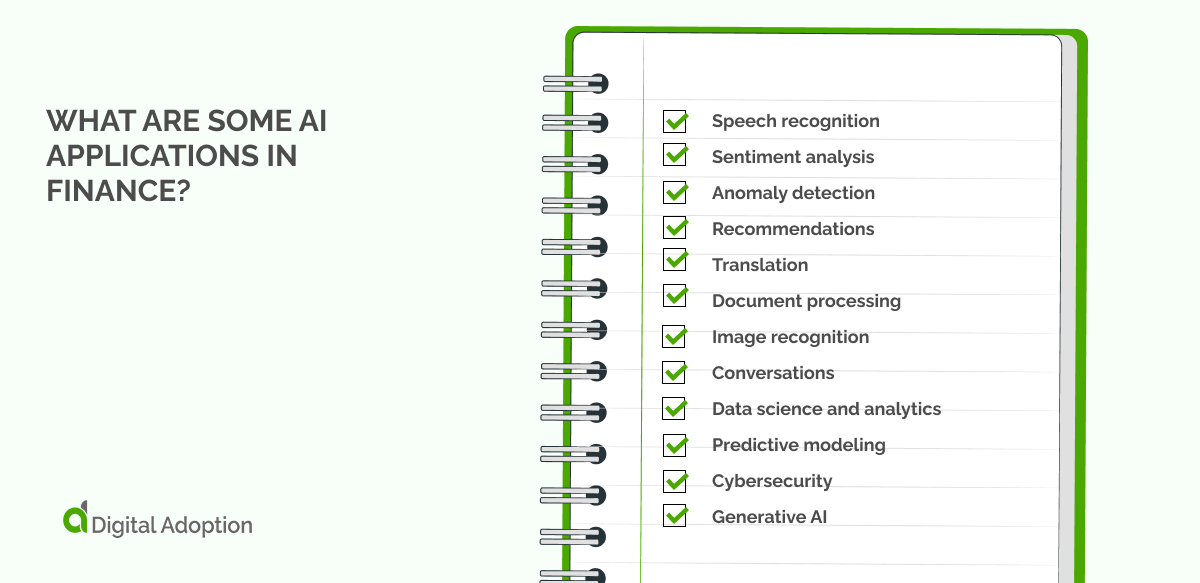
Artificial intelligence (AI) is revolutionizing the finance industry by introducing advanced applications that enhance decision-making and operational efficiency.
AI is reshaping how financial institutions manage risk and deliver personalized customer experiences.
Let’s take a closer look.
Speech recognition
Speech recognition enables users to interact hands-free with banking systems, enhancing security and convenience. Customers can authenticate transactions and access account details through voice commands.
In trading, speech recognition facilitates real-time updates and swift order executions. It also improves trader efficiency and responsiveness to market changes. It can accurately convert spoken words into actionable data, streamlining customer service and functional workflows within financial institutions. This enables intuitive user interfaces across digital platforms.
This is a pivotal advancement in user experience and operational resilience in the financial sector.
Sentiment analysis
Sentiment analysis uses natural language processing to interpret and quantify market sentiment from textual data sources.
This technology analyzes massive data sets from social media, news articles, and financial reports. It accurately assesses public perception and investor sentiment. Financial institutions use this analysis to make informed decisions about market trends, customer sentiment, and investment opportunities based on the tone and context of communications.
This real-time analysis helps adjust trading strategies and optimize risk management practices. It also ensures proactive responses to evolving market dynamics and enhances decision-making processes.
Anomaly detection
Anomaly detection is pivotal for identifying irregular patterns within extensive datasets. This technology detects unusual behaviors in transactions and market activities, enhancing fraud prevention and risk management strategies.
Advanced machine learning algorithms enable financial institutions to monitor and respond to anomalies in real-time. This helps fortify security and ensure operational resilience.
Anomaly detection also optimizes operational efficiency by pinpointing discrepancies in trading activities and market behaviors. It enables timely interventions to mitigate risks and enhance overall performance.
Recommendations
AI algorithms generate recommendations that provide valuable insights into financial decision-making. They analyze historical data, market trends, and customer behaviors to offer personalized investment advice and portfolio recommendations.
Machine learning models empower financial advisors to optimize asset allocation strategies, which can be tailored to individual risk profiles and financial goals. AI-driven recommendations enhance customer engagement by delivering timely insights and actionable suggestions, which breeds trust and satisfaction.
Integrating these technologies empowers financial institutions to offer more informed, responsive, personalized services. This improves client outcomes and drives competitive advantage in the evolving financial landscape.
Translation
AI-powered translation capabilities are transforming finance by breaking language barriers and facilitating seamless communication across global markets.
This technology ensures accurate and efficient financial documents, reports, and communications translation. It also enables international collaboration and regulatory compliance for financial institutions. It leverages neural networks and NLP to confidently engage with stakeholders worldwide, allowing them to translate complex financial information accurately while preserving context.
AI-driven translation tools streamline operations, enhance transparency, and support decision-making by providing timely access to multilingual data and insights. This capability is crucial in expanding market reach, boosting global partnerships, and driving innovation within the financial industry.
Document processing
Intelligent document processing automates and optimizes the handling of extensive paperwork and digital documents.
This technology swiftly extracts and analyzes data from forms, contracts, and financial statements. Machine learning algorithms streamline document workflows, reducing manual errors and processing times for greater efficiency. It also enhances compliance with regulatory standards by facilitating consistent and thorough document analysis.
It enables rapid information retrieval, supports informed decision-making, and boosts overall operational efficiency. This empowers professionals to focus on strategic initiatives while upholding data integrity and security standards.
Image recognition
Image recognition technology in finance is changing how institutions analyze and use visual data.
It automates the analysis of images like checks, IDs, and financial documents. This improves processes such as document verification and fraud detection. Advanced algorithms help financial entities interpret and extract information from images, minimizing errors.
Image recognition also enhances customer experience by enabling faster and more secure document handling, ensuring compliance with regulatory standards. This technology fosters innovation in financial services by integrating visual data into decision-making processes, enhancing risk management and operational insights.
Conversations
Conversations in finance are being transformed through advanced digital communication tools that facilitate seamless interaction between institutions and clients.
These tools enable real-time dialogue across multiple platforms, enhancing customer engagement and satisfaction. Financial organizations leverage these capabilities to provide personalized assistance, address inquiries promptly, and offer tailored solutions.
Efficient communication channels, like interactive websites and mobile apps, allow institutions to optimize service delivery and ensure customers receive a responsive experience. Conversations also play a crucial role in internal operations, enabling collaboration and knowledge sharing.
Data science and analytics
Data science and analytics are essential tools in finance. They help institutions analyze large datasets to make informed decisions and improve operations.
These fields use statistics and models to find trends in financial data. Financial companies use them to manage risk better, invest smarter, and work more efficiently.
Data insights also help understand customers, personalize services, and predict market trends. These skills are like a superpower, helping them follow rules, innovate, stay competitive, and gain valuable insights.
Predictive modeling
Predictive modeling is essential in modern finance. It utilizes statistical methodologies to forecast future trends and behaviors based on historical data analysis.
This method enables financial institutions to anticipate market movements, understand customer preferences, and optimize investment strategies. Predictive modeling identifies patterns and correlations within datasets. This helps mitigate risks, allocate resources effectively, and improve operational efficiency.
It also supports personalized customer interactions and targeted marketing efforts, enhancing service delivery and customer satisfaction. Ultimately, predictive modeling empowers finance professionals to navigate uncertainties and capitalize on opportunities in a dynamic economic environment.
Cybersecurity
Cybersecurity is critical in the finance sector. It ensures the protection of sensitive information and transactions from cyber threats.
Financial institutions need strong cybersecurity. It protects client data and builds trust. They use effective strategies and technology. This keeps data safe, blocks unauthorized access, and reduces cyberattack risks.
Strong cybersecurity helps them follow regulations, stay financially stable, and make operations more resilient. They achieve this with advanced encryption, multi-layered authentication, and continuous monitoring to find and respond quickly to threats.
Prioritizing cybersecurity also safeguards client assets and reinforces digital trust in financial services.
Generative AI
Generative AI is reshaping finance using computational algorithms to create novel data and simulations that simulate real-world scenarios.
Generative AI is transforming finance with powerful computer programs. These programs create realistic fake data for testing and training. This fake data helps build better models to predict the future and manage risks.
Generative AI also analyzes customer behavior and preferences by recommending personalized financial products and services.
It also supports decision-making processes by providing insights derived from complex data analysis. Generative AI empowers finance professionals to improve operational efficiency and deliver enhanced customer experiences in an increasingly data-driven world.
What are some examples of AI in finance?
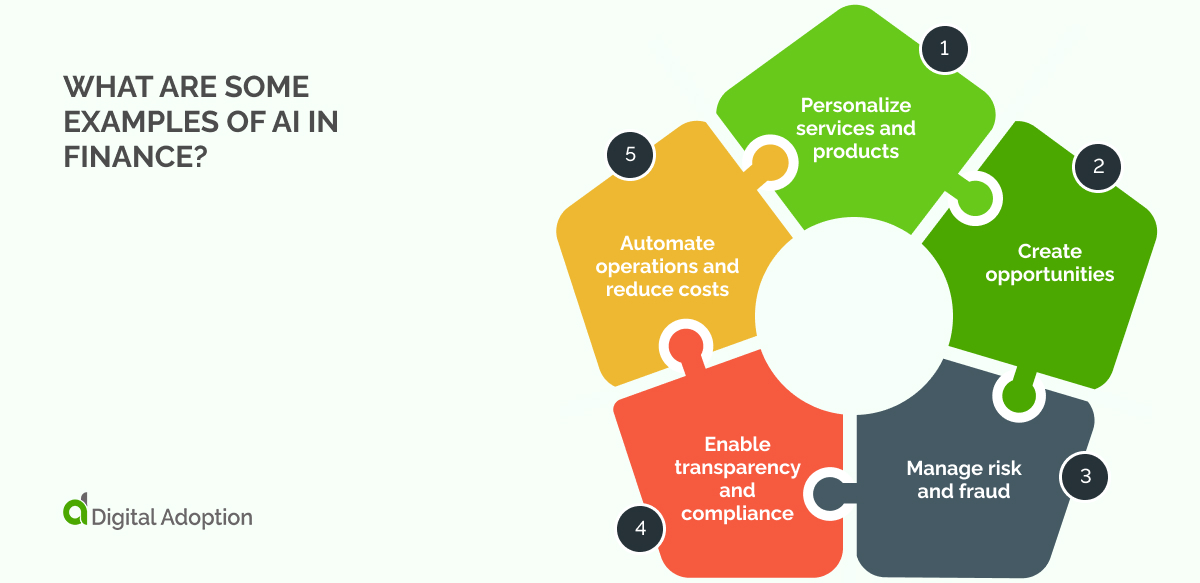
Understanding examples of AI in finance is crucial as it illustrates how technology enhances efficiency, innovation, and regulatory compliance in the industry. AI’s impact reshapes operations and decision-making paradigms from automating complex processes to predicting market trends.
Personalize services and products
AI enables financial institutions to personalize services and products for their customers. AI algorithms can identify individual preferences and behaviors by analyzing vast data sets.
Banks can offer tailored financial advice, customized investment portfolios, and personalized banking services. For instance, AI-driven chatbots provide real-time assistance, while machine learning models predict customer needs and suggest relevant financial products. Personalized services enhance customer satisfaction and loyalty, driving better engagement and retention.
AI’s ability to deliver bespoke financial solutions transforms the customer experience, making it more intuitive and responsive to individual needs.
Create opportunities
AI creates numerous opportunities in the finance sector by optimizing processes and uncovering new revenue streams.
Powerful data analysis and machine learning are giving financial companies a big edge. They can now spot upcoming market trends, better assess investment risks, and even create new financial products. AI can also trade super fast using complex computer programs, making better decisions than humans in a fraction of a second.
Additionally, AI-driven fraud detection systems help secure transactions and build customer trust. By leveraging AI, financial firms can streamline operations, reduce costs, and capitalize on new business opportunities, ultimately driving growth and maintaining a competitive edge in the industry.
Manage risk and fraud
AI plays a crucial role in managing risk and fraud in the finance sector. Advanced machine learning algorithms analyze vast datasets to identify unusual patterns and behaviors indicative of fraudulent activities.
Financial institutions are deploying real-time monitoring systems powered by AI. These systems detect and flag suspicious transactions, significantly reducing fraud. AI-driven risk management tools assess creditworthiness more accurately than traditional methods.
They can predict potential defaults with greater precision. These adaptive AI systems enhance their predictive capabilities by continuously learning from new data. This provides financial institutions with robust tools to mitigate risks and safeguard assets.
A proactive approach significantly strengthens the security and reliability of financial operations.
Enable transparency and compliance
AI is becoming a game-changer for financial institutions, promoting both transparency and compliance.
Advanced algorithms can quickly analyze massive datasets, automating regulatory checks and ensuring companies follow the rules. These AI tools also act as watchdogs, identifying irregularities and guaranteeing accurate reporting. Real-time transaction monitoring further strengthens compliance efforts.
By integrating AI solutions, financial companies streamline operations and build trust with regulators and clients. They can ultimately create a more stable and transparent economic environment. This approach mitigates risks and promotes a healthy financial system for long-term growth.
Automate operations and reduce costs
AI’s powerful automation is transforming efficiency and costs in finance. Advanced algorithms and machine learning streamline tasks like data entry, reconciliation, and customer service. This speeds things up and ensures accuracy, boosting overall efficiency.
AI goes a step further with predictive analytics. Analyzing past data and forecasting trends helps allocate resources wisely and avoid unnecessary spending. These AI technologies deliver significant cost savings and make resource allocation more flexible. This keeps financial firms competitive in today’s dynamic economy.
AI in Financial Services: Compliance, Regulation, and Risk
No discussion of AI in finance is complete without addressing the regulatory environment — and in 2025–2026, this has become one of the most active areas of policy development globally.
Why compliance is a first-order concern. Finance is a highly regulated industry by design. AI systems that influence credit decisions, trading strategies, or customer communications are subject to existing frameworks — Fair Lending laws, GDPR, MiFID II, the SEC’s AI guidance — as well as new AI-specific regulations coming into force across jurisdictions. Any financial institution deploying AI at scale is simultaneously deploying a compliance program to govern it.
Explainability requirements. A recurring challenge with AI in credit and underwriting is model explainability. When an AI model denies a loan, the institution must be able to explain why in terms a regulator or customer can understand. This has driven demand for explainable AI (XAI) techniques — gradient-based attribution, LIME, SHAP values — that translate model outputs into human-readable reasoning. Banks are investing heavily in this capability ahead of expected regulatory mandates.
The EU AI Act and its financial implications. The EU AI Act, which entered phased enforcement in 2024–2025, classifies many financial AI applications — particularly credit scoring and insurance pricing — as “high-risk.” High-risk AI systems require conformity assessments, ongoing human oversight, and detailed technical documentation. For global banks operating in Europe, this has triggered compliance infrastructure investments in the hundreds of millions of dollars.
Model risk management (MRM). Regulators including the OCC and Federal Reserve have issued guidance (SR 11-7) requiring banks to validate AI and machine learning models with the same rigor as traditional statistical models. This means third-party model validation, ongoing performance monitoring, and clear escalation processes when models drift or produce unexpected outputs.
AI’s future impact on finance
The future of AI in finance promises a dramatic transformation. Cutting-edge technologies will revolutionize traditional practices, driving innovation across the industry.
Integrating artificial intelligence into financial services will deliver significant benefits as it evolves. We can expect enhanced efficiency, improved decision-making, and a profound reshaping of how customers interact with financial services.
AI’s role in personalized finance is set to redefine customer experiences. AI can analyze customer behaviors and preferences through sophisticated algorithms and natural language processing to offer tailored financial advice and product recommendations. This improves customer satisfaction and deepens client engagement and loyalty.
AI-driven automation is also expected to streamline operational processes within financial institutions. Tasks such as document processing, compliance monitoring, and fraud detection can be performed more efficiently and accurately through AI technologies, freeing human resources for more strategic and value-added activities.Looking ahead, the adoption of AI in finance is backed by promising data and real-world examples showcasing its benefits. For instance, the Government Office for Science has demonstrated that AI-powered trading algorithms can outperform human traders in speed and accuracy, improving investment outcomes.